

Best AZ-104 Exam Dumps for the Preparation of Latest Exam Questions
AZ-104 Actual Questions 100% Same Braindumps with Actual Exam!
Microsoft AZ-104 is a certification exam designed for professionals who want to validate their skills and knowledge in Microsoft Azure administration. It is the successor to the AZ-103 exam, which was retired in August 2020. The AZ-104 certification exam measures the candidate's ability to manage Azure resources, implement and manage storage, configure and manage virtual networks, and monitor and backup Azure resources.
NEW QUESTION # 124
You have a general-purpose v1 Azure Storage account named storage1 that uses locally-redundant storage (LRS).
You need to ensure that the data in the storage account is protected if a zone fails. The solution must minimize costs and administrative effort.
What should you do first?
- A. Modify the Replication setting of storage1.
- B. Configure object replication rules.
- C. Upgrade the account to general-purpose v2.
- D. Create a new storage account.
Answer: C
Explanation:
Reference:
https://docs.microsoft.com/en-us/azure/storage/common/storage-redundancy
NEW QUESTION # 125
You have a network security group (NSG) named NSG1 that has the rules defined in the exhibit. (Click the Exhibit tab.)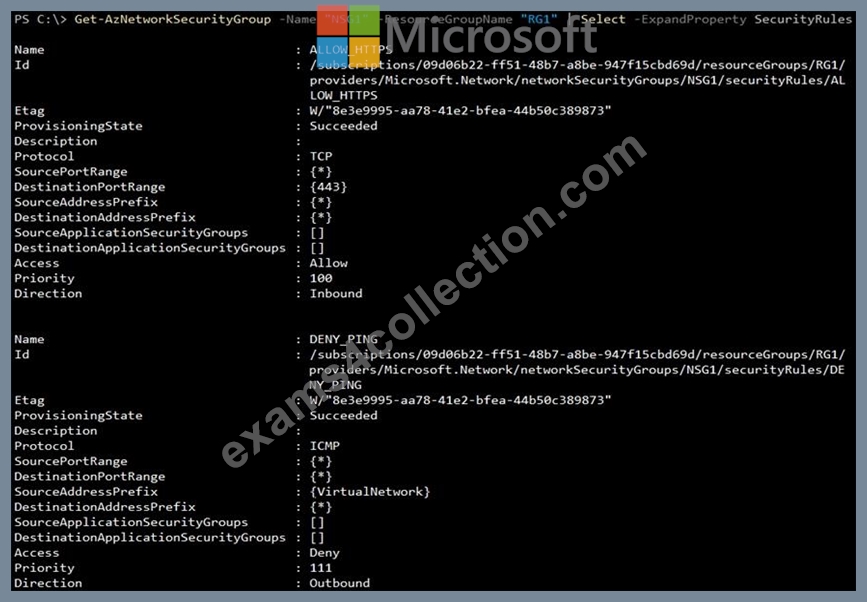
NSG1 is associated to a subnet named Subnet1. Subnet1 contains the virtual machines shown in the following table.
You need to add a rule to NSG1 to ensure that VM1 can ping VM2. The solution must use the principle of least privilege.
How should you configure the rule? To answer, select the appropriate options in the answer area.
NOTE: Each correct selection is worth one point.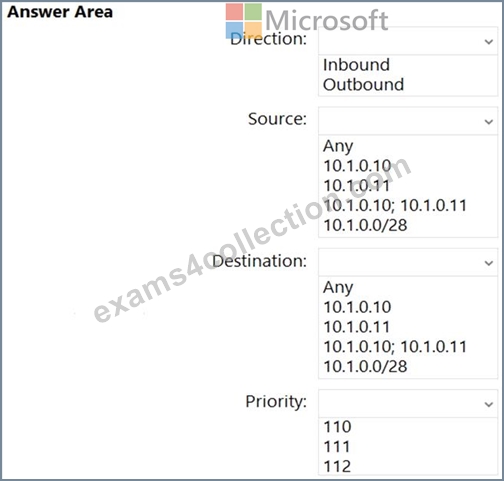
Answer:
Explanation: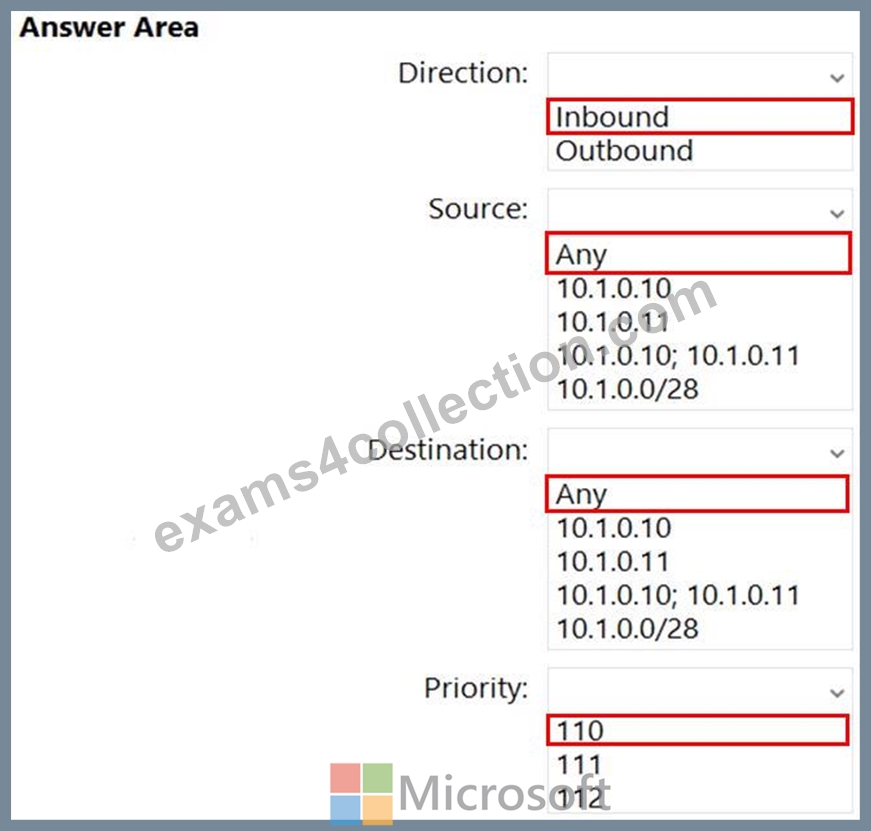
Reference:
https://www.thomasmaurer.ch/2019/09/how-to-enable-ping-icmp-echo-on-an-azure-vm/
NEW QUESTION # 126
You need to define a custom domain name for Azure AD to support the planned infrastructure.
Which domain name should you use?
- A. humongousinsurance.local
- B. humongousinsurance.onmicrosoft.com
- C. ad.humongousinsurance.com
- D. humongousinsurance.com
Answer: A
Explanation:
Explanation
Every Azure AD directory comes with an initial domain name in the form of domainname.onmicrosoft.com.
The initial domain name cannot be changed or deleted, but you can add your corporate domain name to Azure AD as well. For example, your organization probably has other domain names used to do business and users who sign in using your corporate domain name. Adding custom domain names to Azure AD allows you to assign user names in the directory that are familiar to your users, such as '[email protected].' instead of
'alice@domain name.onmicrosoft.com'.
Scenario:
Network Infrastructure: Each office has a local data center that contains all the servers for that office. Each office has a dedicated connection to the Internet.
Humongous Insurance has a single-domain Active Directory forest named humongousinsurance.com Planned Azure AD Infrastructure: The on-premises Active Directory domain will be synchronized to Azure AD.
References: https://docs.microsoft.com/en-us/azure/active-directory/fundamentals/add-custom-domain
NEW QUESTION # 127
Peering for VNET2 is configured as shown in the following exhibit.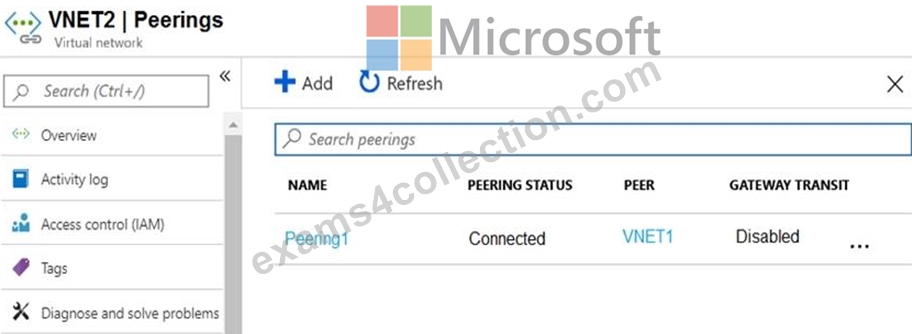
Peering for VNET3 is configured as shown in the following exhibit.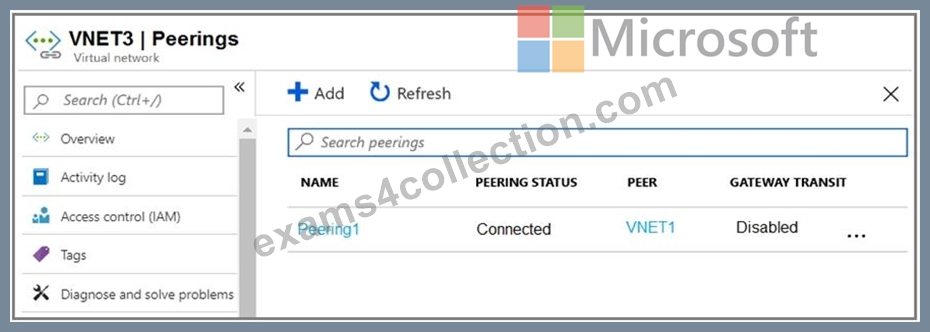
How can packets be routed between the virtual networks? To answer, select the appropriate options in the answer area.
NOTE: Each correct selection is worth one point.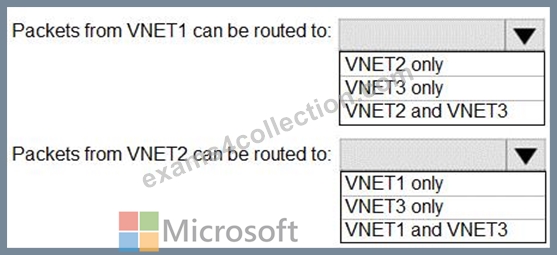
Answer:
Explanation: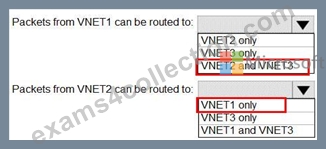
Reference:
https://docs.microsoft.com/en-us/azure/virtual-network/virtual-network-peering-overview
NEW QUESTION # 128
Note: This question is part of a series of questions that present the same scenario. Each question in the series contains a unique solution that might meet the stated goals. Some question sets might have more than one correct solution, while others might not have a correct solution.
After you answer a question in this section, you will NOT be able to return to it. As a result, these questions will not appear in the review screen.
You have an app named App1 that is installed on two Azure virtual machines named VM1 and VM2. Connections to App1 are managed by using an Azure Load Balancer.
The effective network security configurations for VM2 are shown in the following exhibit.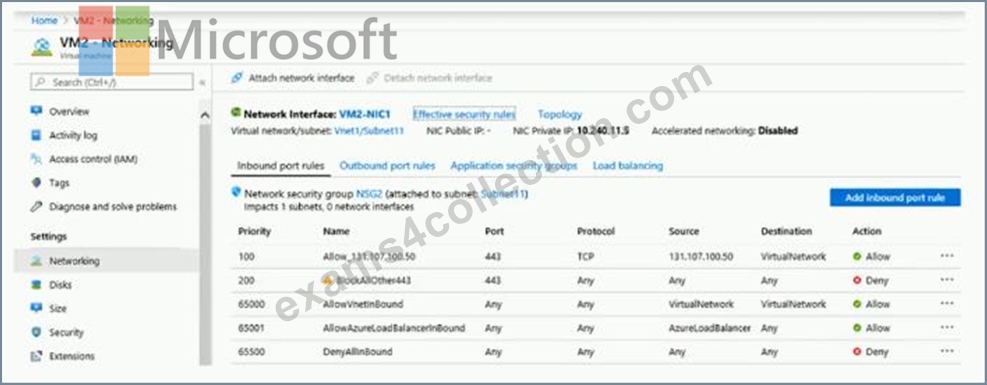
You discover that connections to App1 from 131.107.100.50 over TCP port 443 fail. You verify that the Load Balancer rules are configured correctly.
You need to ensure that connections to App1 can be established successfully from 131.107.100.50 over TCP port 443.
Solution: You create an inbound security rule that denies all traffic from the 131.107.100.50 source and has a cost of 64999.
Does this meet the goal?
- A. Yes
- B. No
Answer: B
NEW QUESTION # 129
You have an Azure subscription named Subscription1.
You plan to deploy an Ubuntu Server virtual machine named VM1 to Subscription1.
You need to perform a custom deployment of the virtual machine. A specific trusted root certification authority (CA) must be added during the deployment.
What should you do? To answer, select the appropriate options in the answer area.
NOTE: Each correct selection is worth one point.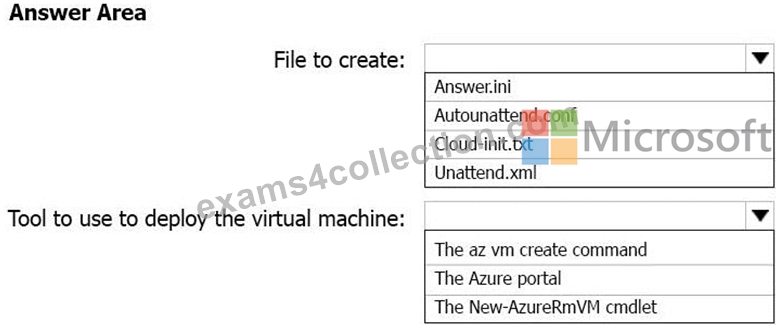
Answer:
Explanation: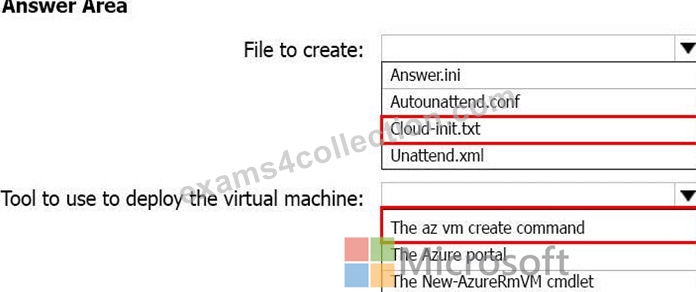
Explanation:
Box 1: Cloud-init.txt
Cloud-init.txt is used to customize a Linux VM on first boot up. It can be used to install packages and write files, or to configure users and security. No additional steps or agents are required to apply your configuration.
Box 2: The az vm create command
Once Cloud-init.txt has been created, you can deploy the VM with az vm create cmdlet, sing the --customdata parameter to provide the full path to the cloud-init.txt file.
References:
https://docs.microsoft.com/en-us/azure/virtual-machines/linux/tutorial-automate-vm-deployment
NEW QUESTION # 130
You have an on-premises network that you plan to connect to Azure by using a site-to-site VPN.
In Azure, you have an Azure virtual network named VNet1 that uses an address space of 10.0.0.0/16. VNet1 contains a subnet named Subnet1 that uses an address space of 10.0.0.0/24.
You need to create a site-to-site VPN to Azure.
Which four actions should you perform in sequence? To answer, move the appropriate actions from the list of actions to the answer area and arrange them in the correct order.
NOTE: More than one order of answer choices is correct. You will receive credit for any of the correct orders you select.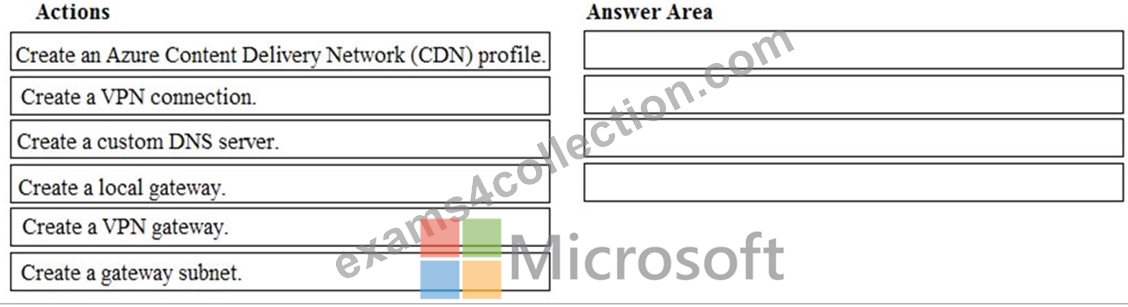
Answer:
Explanation: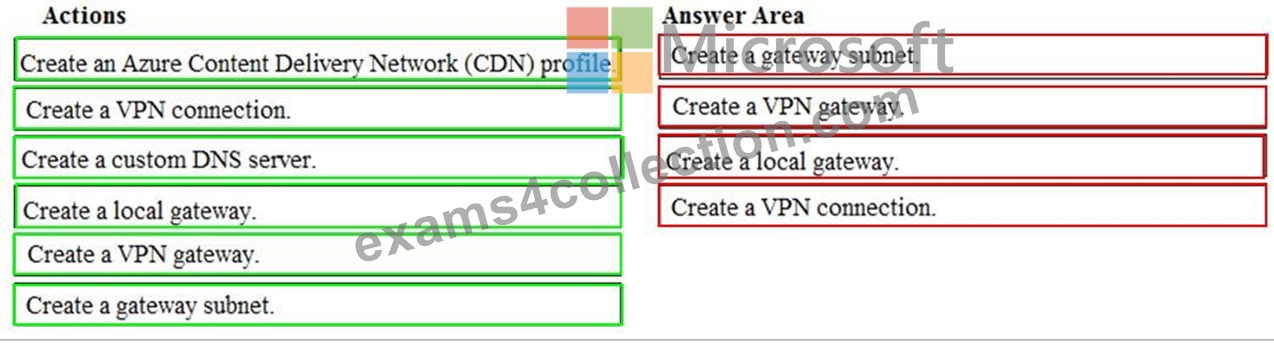
Explanation:
A Site-to-Site VPN gateway connection is used to connect your on-premises network to an Azure virtual network over an IPsec/IKE (IKEv1 or IKEv2) VPN tunnel. This type of connection requires a VPN device located on-premises that has an externally facing public IP address assigned to it. For more information about VPN gateways, see About VPN gateway.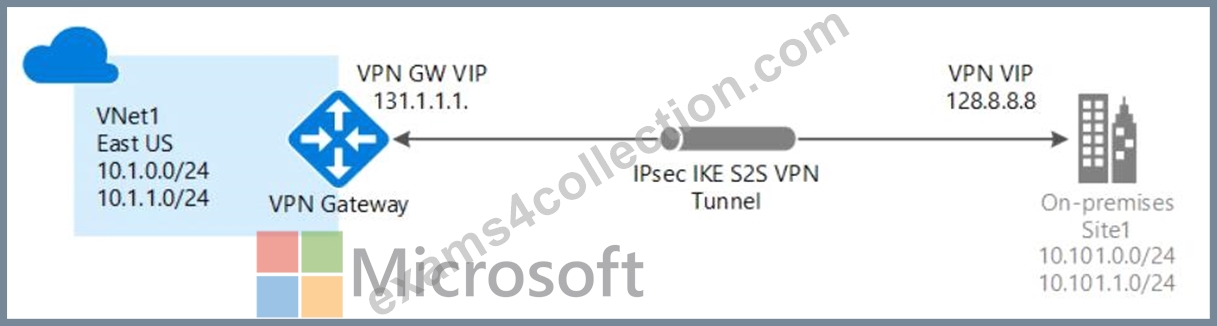
1. Create a virtual network
You can create a VNet with the Resource Manager deployment model and the Azure portal
2. Create the gateway subnet :
The virtual network gateway uses specific subnet called the gateway subnet. The gateway subnet is part of the virtual network IP address range that you specify when configuring your virtual network. It contains the IP addresses that the virtual network gateway resources and services use.
3. Create the VPN gateway :
You create the virtual network gateway for your VNet. Creating a gateway can often take 45 minutes or more, depending on the selected gateway SKU.
4. Create the local network gateway:
The local network gateway typically refers to your on-premises location. You give the site a name by which Azure can refer to it, then specify the IP address of the on-premises VPN device to which you will create a connection. You also specify the IP address prefixes that will be routed through the VPN gateway to the VPN device. The address prefixes you specify are the prefixes located on your on-premises network. If your on-premises network changes or you need to change the public IP address for the VPN device, you can easily update the values later.
5. Configure your VPN device:
Site-to-Site connections to an on-premises network require a VPN device. In this step, you configure your VPN device. When configuring your VPN device, you need the following:
A shared key. This is the same shared key that you specify when creating your Site-to-Site VPN connection. In our examples, we use a basic shared key. We recommend that you generate a more complex key to use.
The Public IP address of your virtual network gateway. You can view the public IP address by using the Azure portal, PowerShell, or CLI. To find the Public IP address of your VPN gateway using the Azure portal, navigate to Virtual network gateways, then click the name of your gateway.
6. Create the VPN connection:
Create the Site-to-Site VPN connection between your virtual network gateway and your on-premises VPN device.
Reference:
https://docs.microsoft.com/en-us/azure/vpn-gateway/vpn-gateway-howto-site-to-site-resource-manager-portal
NEW QUESTION # 131
You are evaluating the name resolution for the virtual machines after the planned implementation of the Azure networking infrastructure.
For each of the following statements, select Yes if the statement is true. Otherwise, select No.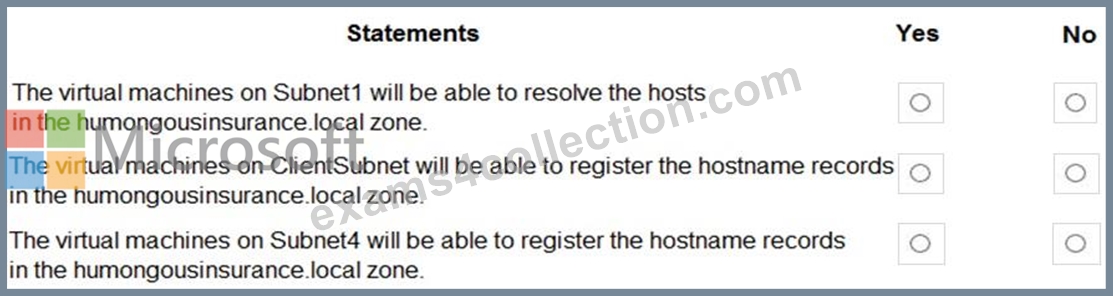
Answer:
Explanation: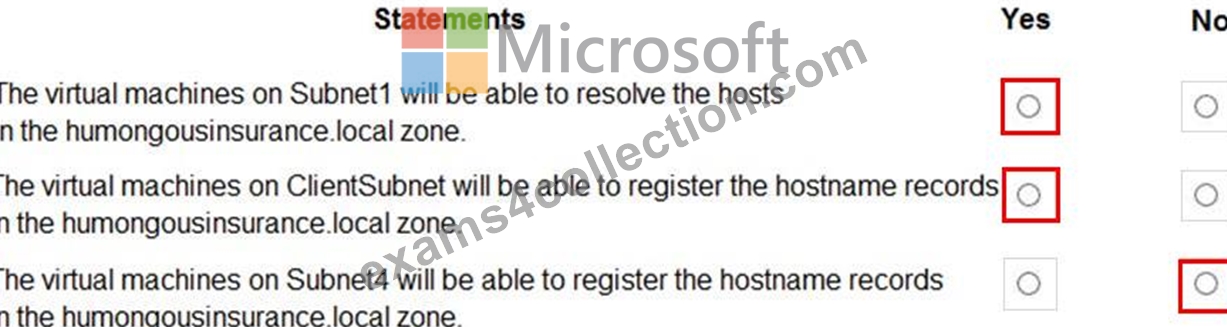
Reference:
https://docs.microsoft.com/en-us/azure/dns/private-dns-overview
https://docs.microsoft.com/en-us/azure/virtual-network/virtual-networks-name-resolution-for-vms-and-role-instances
NEW QUESTION # 132
You have an Azure subscription that contains the resources shown in the following table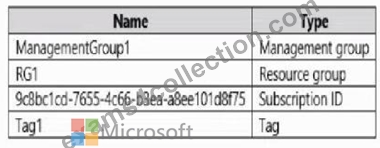
In Azure Cloud Shell, you need to create a virtual machine by using an Azure Resource Manager (ARM) template.
How should you complete the command? To answer, select the appropriate options in the answer area, NOTE: Each correct selection is worth one point.
Answer:
Explanation:
Explanation: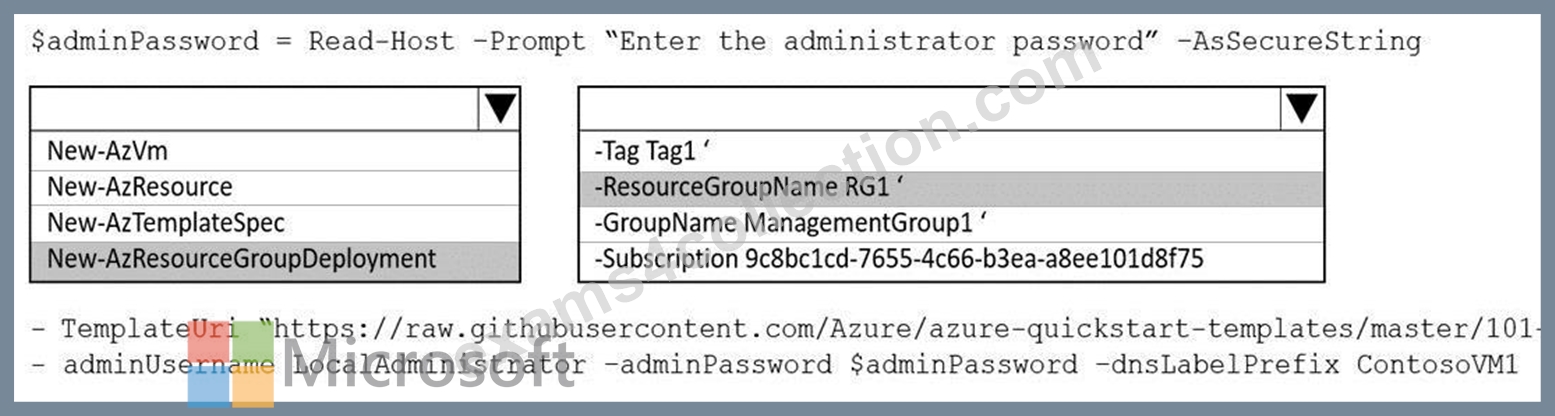
Reference:
https://docs.microsoft.com/en-us/powershell/module/az.resources/new-azresourcegroupdeployment?
view=azps-6.6.0
NEW QUESTION # 133
You have an Azure subscription.
You plan to use Azure Resource Manager templates to deploy 50 Azure virtual machines that will be part of the same availability set.
You need to ensure that as many virtual machines as possible are available if the fabric fails or during servicing.
How should you configure the template? To answer, select the appropriate options in the answer area.
NOTE: Each correct selection is worth one point.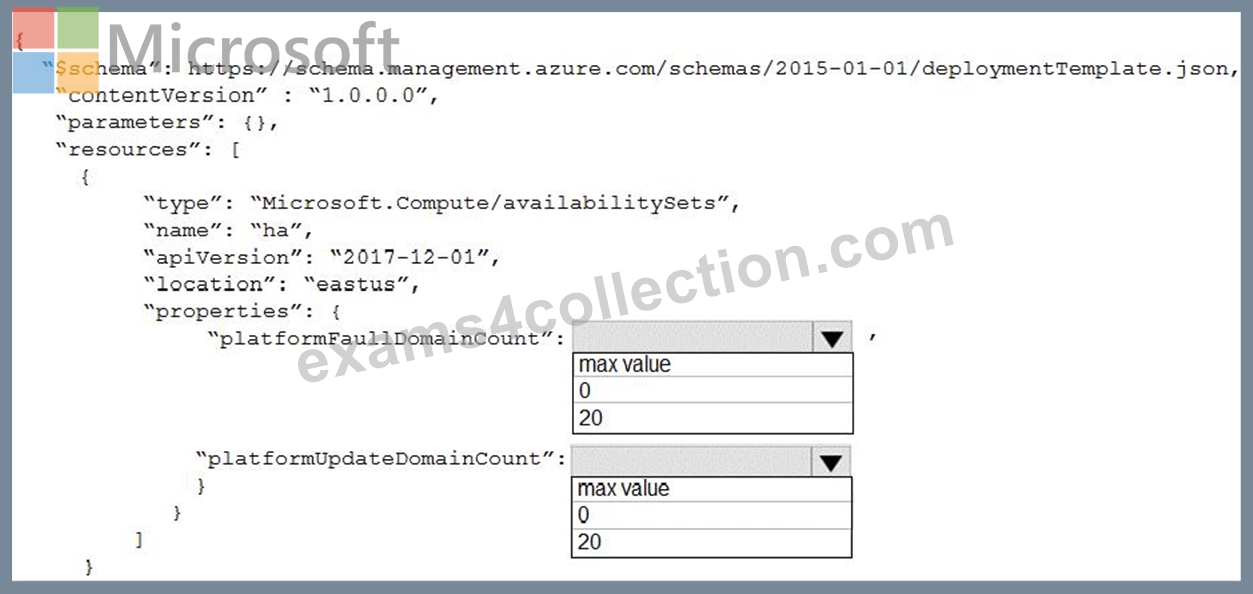
Answer:
Explanation: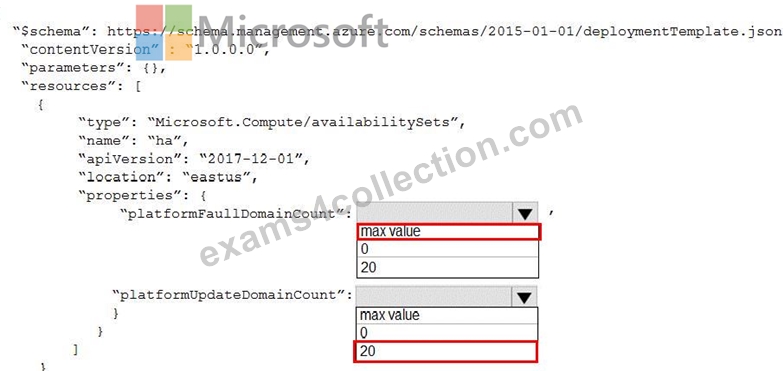
Explanation:
Use max for platformFaultDomainCount
2 or 3 is max value, depending on which region you are in.
Use 20 for platformUpdateDomainCount
Increasing the update domain (platformUpdateDomainCount) helps with capacity and availability planning when the platform reboots nodes. A higher number for the pool (20 is max) means that fewer of their nodes in any given availability set would be rebooted at once.
References:
https://www.itprotoday.com/microsoft-azure/check-if-azure-region-supports-2-or-3-fault-domains-managed-disks
https://github.com/Azure/acs-engine/issues/1030
NEW QUESTION # 134
You need to create an Azure Storage account that meets the following requirements:
* Minimizes costs
* Supports hot, cool, and archive blob tiers
* Provides fault tolerance if a disaster affects the Azure region where the account resides How should you complete the command? To answer, select the appropriate options in the answer are a. NOTE: Each correct selection is worth one point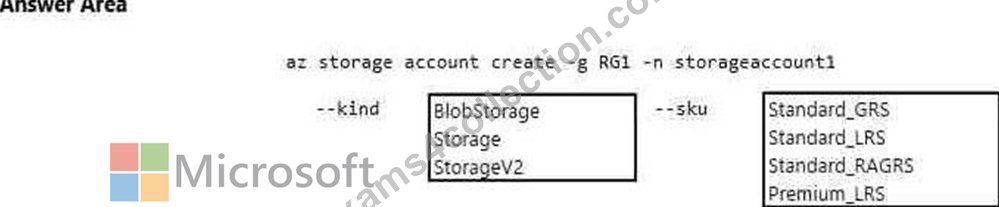
Answer:
Explanation: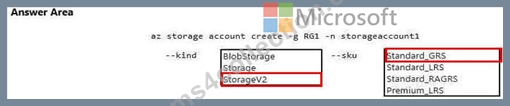
Reference:
https://docs.microsoft.com/en-us/azure/storage/common/storage-redundancy-grs
https://docs.microsoft.com/en-us/azure/storage/blobs/storage-blob-storage-tiers
NEW QUESTION # 135
You have an Azure subscription that contains the Azure virtual machines shown in the following table.
You configure the network interfaces of the virtual machines to use the settings shown in the following table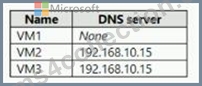
From the settings of VNET1, you configure the DNS servers shown in the following exhibit.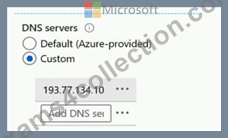
The virtual machines can successfully connect to the DNS server that has an IP address of 192.168.10.15 and the DNS server that has an IP address of 193.77.134.10.
For each of the following statements, select Yes if the statement is true. Otherwise, select No.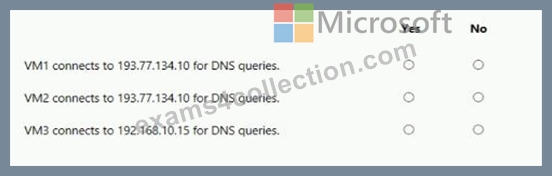
Answer:
Explanation: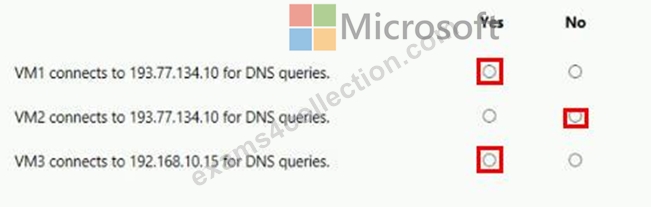
Reference:
https://docs.microsoft.com/en-us/azure/virtual-network/virtual-networks-faq#name-resolution-dns
NEW QUESTION # 136
You plan to deploy five virtual machines to a virtual network subnet.
Each virtual machine will have a public IP address and a private IP address.
Each virtual machine requires the same inbound and outbound security rules.
What is the minimum number of network interfaces and network security groups that you require? To answer, select the appropriate options in the answer area.
NOTE: Each correct selection is worth one point.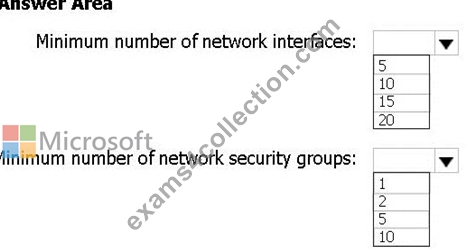
Answer:
Explanation: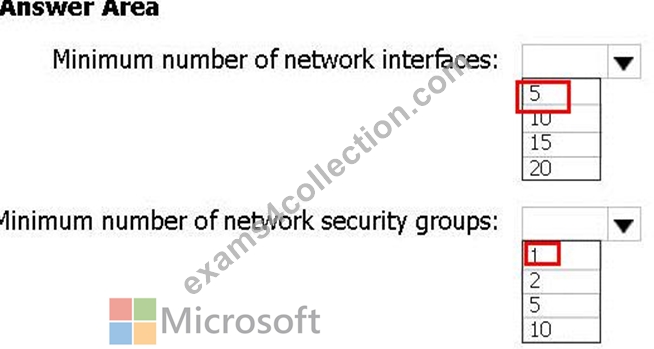
Reference:
https://docs.microsoft.com/en-us/azure/virtual-network/virtual-network-network-interface-addresses
NEW QUESTION # 137
You have an Azure subscription named Subscription1 that contains the virtual networks in the following table.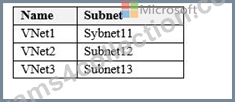
Subscripton1 contains the virtual machines in the following table.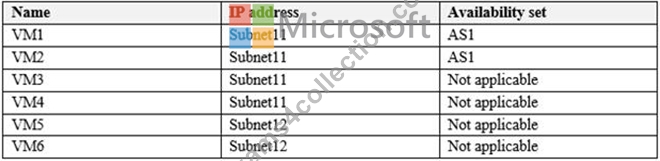
In Subscription1, you create a load balancer that has the following configurations:
* Name: LB1
* SKU: Basic
* Type: Internal
* Subnet: Subnet12
* Virtual network: VNET1
For each of the following statements, select Yes if the statement is true. Otherwise, select No.
NOTE: each correct selection is worth one point.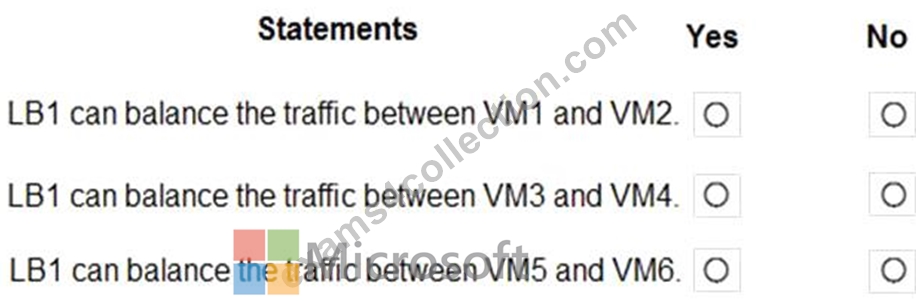
Answer:
Explanation: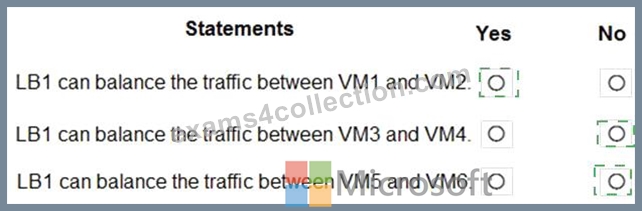
Explanation: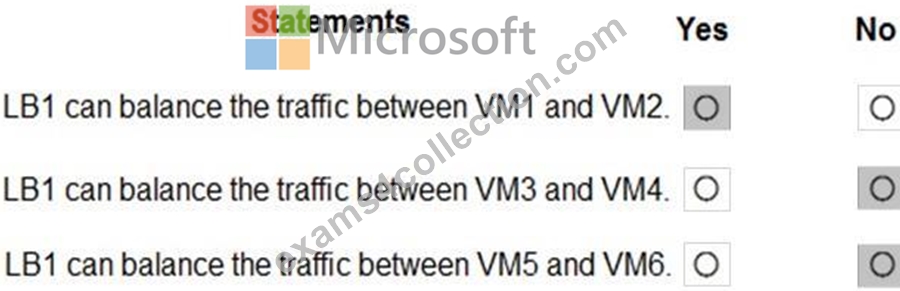
NEW QUESTION # 138
You need to use Azure Automation State Configuration to manage the ongoing consistency of virtual machine configurations.
Which five actions should you perform in sequence? To answer, move the appropriate action from the list of actions to the answer area and arrange them in the correct order.
NOTE: More than one order of answer choices is correct. You will receive credit for any of the correct orders you select.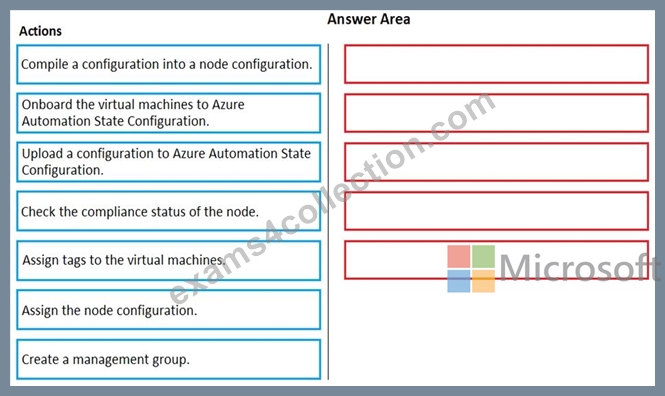
Answer:
Explanation: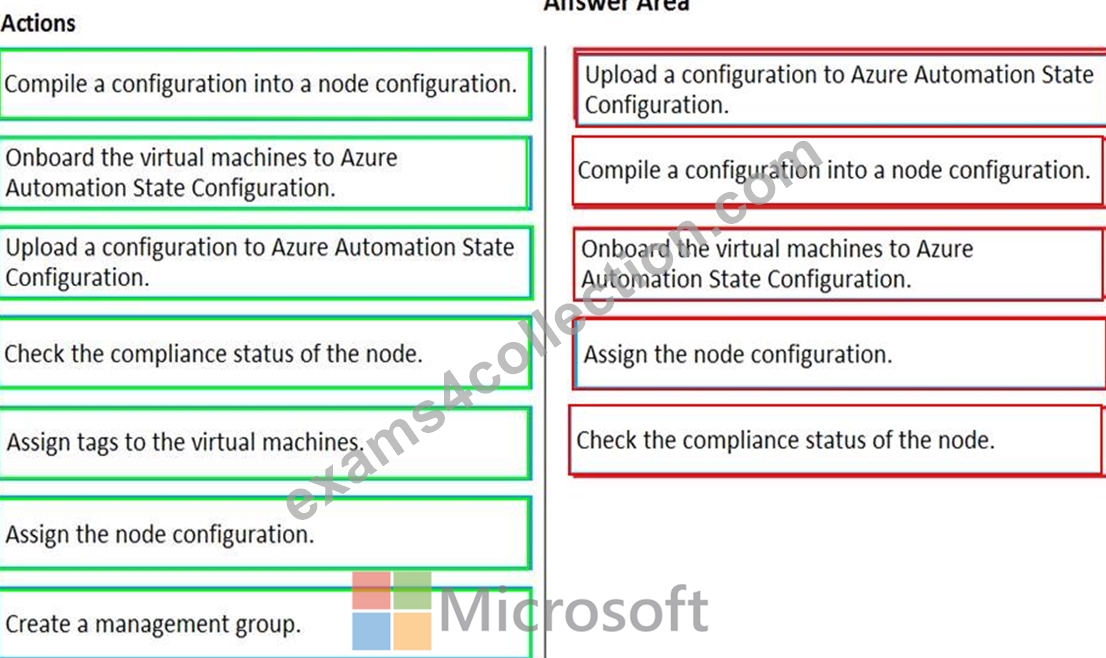
Reference:
https://docs.microsoft.com/en-us/azure/automation/automation-dsc-getting-started
NEW QUESTION # 139
......
AZ-104 Study Material, Preparation Guide and PDF Download: https://easytest.exams4collection.com/AZ-104-latest-braindumps.html
