

[UPDATED 2025] Getting Databricks-Certified-Data-Engineer-Associate Certification Made Easy!
Databricks-Certified-Data-Engineer-Associate Exam Crack Test Engine Dumps Training With 102 Questions
The GAQM Databricks-Certified-Data-Engineer-Associate (Databricks Certified Data Engineer Associate) Exam is a professional certification exam designed to measure the knowledge, skills, and abilities of data engineers who work with Databricks. Databricks is a cloud-based big data processing and analytics platform that is used by organizations of all sizes to manage large volumes of data and gain valuable insights. Databricks-Certified-Data-Engineer-Associate exam is intended for data engineers who are responsible for designing, building, and maintaining data pipelines, data lakes, and data warehouses using Databricks.
Databricks-Certified-Data-Engineer-Associate exam is an essential certification for data engineers who work with Databricks. Databricks-Certified-Data-Engineer-Associate exam measures the candidate's knowledge, skills, and abilities in Databricks architecture, data ingestion, data processing, data engineering, data storage, and data management. Databricks Certified Data Engineer Associate Exam certification is recognized globally and is a valuable asset for data engineers who want to advance their careers and demonstrate their proficiency in Databricks.
Databricks Certified Data Engineer Associate certification is a highly sought-after certification in the data engineering industry. Databricks Certified Data Engineer Associate Exam certification demonstrates that a candidate has the knowledge and skills required to design and build data pipelines using Databricks. Databricks Certified Data Engineer Associate Exam certification is recognized globally and is highly valued by employers in various industries.
NEW QUESTION # 60
An engineering manager wants to monitor the performance of a recent project using a Databricks SQL query. For the first week following the project's release, the manager wants the query results to be updated every minute. However, the manager is concerned that the compute resources used for the query will be left running and cost the organization a lot of money beyond the first week of the project's release.
Which of the following approaches can the engineering team use to ensure the query does not cost the organization any money beyond the first week of the project's release?
- A. They cannot ensure the query does not cost the organization money beyond the first week of the project's release.
- B. They can set the query's refresh schedule to end on a certain date in the query scheduler.
- C. They can set a limit to the number of individuals that are able to manage the query's refresh schedule.
- D. They can set the query's refresh schedule to end after a certain number of refreshes.
- E. They can set a limit to the number of DBUs that are consumed by the SQL Endpoint.
Answer: B
Explanation:
In Databricks SQL, you can use scheduled query executions to update your dashboards or enable routine alerts. By default, your queries do not have a schedule. To set the schedule, you can use the dropdown pickers to specify the frequency, period, starting time, and time zone. You can also choose to end the schedule on a certain date by selecting the End date checkbox and picking a date from the calendar. This way, you can ensure that the query does not run beyond the first week of the project's release and does not incur any additional cost. Option A is incorrect, as setting a limit to the number of DBUs does not stop the query from running. Option B is incorrect, as there is no option to end the schedule after a certain number of refreshes. Option C is incorrect, as there is a way to ensure the query does not cost the organization money beyond the first week of the project's release. Option D is incorrect, as setting a limit to the number of individuals who can manage the query's refresh schedule does not affect the query's execution or cost. Reference: Schedule a query, Schedule a query - Azure Databricks - Databricks SQL
NEW QUESTION # 61
A new data engineering team has been assigned to work on a project. The team will need access to database customers in order to see what tables already exist. The team has its own group team.
Which of the following commands can be used to grant the necessary permission on the entire database to the new team?
- A. GRANT CREATE ON DATABASE team TO customers;
- B. GRANT CREATE ON DATABASE customers TO team;
- C. GRANT USAGE ON DATABASE customers TO team;
- D. GRANT VIEW ON CATALOG customers TO team;
- E. GRANT USAGE ON CATALOG team TO customers;
Answer: C
Explanation:
1: The correct command to grant the necessary permission on the entire database to the new team is to use the GRANT USAGE command. The GRANT USAGE command grants the principal the ability to access the securable object, such as a database, schema, or table. In this case, the securable object is the database customers, and the principal is the group team. By granting usage on the database, the team will be able to see what tables already exist in the database. Option E is the only option that uses the correct syntax and the correct privilege type for this scenario. Option A uses the wrong privilege type (VIEW) and the wrong securable object (CATALOG). Option B uses the wrong privilege type (CREATE), which would allow the team to create new tables in the database, but not necessarily see the existing ones. Option C uses the wrong securable object (CATALOG) and the wrong principal (customers). Option D uses the wrong securable object (team) and the wrong principal (customers). Reference: GRANT, Privilege types, Securable objects, Principals
NEW QUESTION # 62
Which of the following Structured Streaming queries is performing a hop from a Silver table to a Gold table?
- A.

- B.

- C.

- D.

- E.

Answer: C
Explanation:
The best practice is to use "Complete" as output mode instead of "append" when working with aggregated tables. Since gold layer is work final aggregated tables, the only option with output mode as complete is option E.
NEW QUESTION # 63
A data engineer has left the organization. The data team needs to transfer ownership of the data engineer's Delta tables to a new data engineer. The new data engineer is the lead engineer on the data team.
Assuming the original data engineer no longer has access, which of the following individuals must be the one to transfer ownership of the Delta tables in Data Explorer?
- A. New lead data engineer
- B. Databricks account representative
- C. Workspace administrator
- D. Original data engineer
- E. This transfer is not possible
Answer: C
Explanation:
The workspace administrator is the only individual who can transfer ownership of the Delta tables in Data Explorer, assuming the original data engineer no longer has access. The workspace administrator has the highest level of permissions in the workspace and can manage all resources, users, and groups. The other options are either not possible or not sufficient to perform the ownership transfer. The Databricks account representative is not involved in the workspace management. The transfer is possible and not dependent on the original data engineer. The new lead data engineer may not have the necessary permissions to access or modify the Delta tables, unless granted by the workspace administrator or the original data engineer before leaving. Reference: Workspace access control, Manage Unity Catalog object ownership.
NEW QUESTION # 64
A data engineer is designing a data pipeline. The source system generates files in a shared directory that is also used by other processes. As a result, the files should be kept as is and will accumulate in the directory. The data engineer needs to identify which files are new since the previous run in the pipeline, and set up the pipeline to only ingest those new files with each run.
Which of the following tools can the data engineer use to solve this problem?
- A. Unity Catalog
- B. Data Explorer
- C. Delta Lake
- D. Auto Loader
- E. Databricks SQL
Answer: D
Explanation:
Auto Loader is a tool that can incrementally and efficiently process new data files as they arrive in cloud storage without any additional setup. Auto Loader provides a Structured Streaming source called cloudFiles, which automatically detects and processes new files in a given input directory path on the cloud file storage. Auto Loader also tracks the ingestion progress and ensures exactly-once semantics when writing data into Delta Lake. Auto Loader can ingest various file formats, such as JSON, CSV, XML, PARQUET, AVRO, ORC, TEXT, and BINARYFILE. Auto Loader has support for both Python and SQL in Delta Live Tables, which are a declarative way to build production-quality data pipelines with Databricks. Reference: What is Auto Loader?, Get started with Databricks Auto Loader, Auto Loader in Delta Live Tables
NEW QUESTION # 65
A data analyst has developed a query that runs against Delta table. They want help from the data engineering team to implement a series of tests to ensure the data returned by the query is clean. However, the data engineering team uses Python for its tests rather than SQL.
Which of the following operations could the data engineering team use to run the query and operate with the results in PySpark?
- A. SELECT * FROM sales
- B. spark.delta.table
- C. spark.table
- D. spark.sql
- E. There is no way to share data between PySpark and SQL.
Answer: D
Explanation:
The spark.sql operation allows the data engineering team to run a SQL query and return the result as a PySpark DataFrame. This way, the data engineering team can use the same query that the data analyst has developed and operate with the results in PySpark. For example, the data engineering team can use spark.sql("SELECT * FROM sales") to get a DataFrame of all the records from the sales Delta table, and then apply various tests or transformations using PySpark APIs. The other options are either not valid operations (A, D), not suitable for running a SQL query (B, E), or not returning a DataFrame (A). References: Databricks Documentation - Run SQL queries, Databricks Documentation - Spark SQL and DataFrames.
NEW QUESTION # 66
A data engineer has configured a Structured Streaming job to read from a table, manipulate the data, and then perform a streaming write into a new table.
The cade block used by the data engineer is below: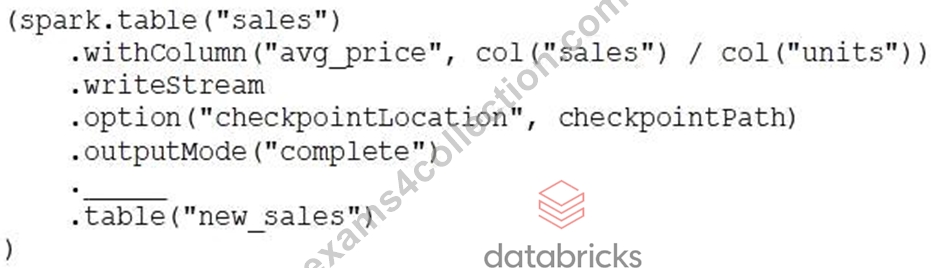
If the data engineer only wants the query to execute a micro-batch to process data every 5 seconds, which of the following lines of code should the data engineer use to fill in the blank?
- A. trigger("5 seconds")
- B. trigger(once="5 seconds")
- C. trigger(processingTime="5 seconds")
- D. trigger(continuous="5 seconds")
- E. trigger()
Answer: C
Explanation:
Explanation
# ProcessingTime trigger with two-seconds micro-batch interval
df.writeStream \
format("console") \
trigger(processingTime='2 seconds') \
start()
https://spark.apache.org/docs/latest/structured-streaming-programming-guide.html#triggers
NEW QUESTION # 67
Which of the following benefits is provided by the array functions from Spark SQL?
- A. An ability to work with an array of tables for procedural automation
- B. An ability to work with data in a variety of types at once
- C. An ability to work with data within certain partitions and windows
- D. An ability to work with time-related data in specified intervals
- E. An ability to work with complex, nested data ingested from JSON files
Answer: C
NEW QUESTION # 68
Which of the following can be used to simplify and unify siloed data architectures that are specialized for specific use cases?
- A. Data warehouse
- B. Data lakehouse
- C. None of these
- D. Data lake
- E. All of these
Answer: B
Explanation:
A data lakehouse is a new paradigm that can be used to simplify and unify siloed data architectures that are specialized for specific use cases. A data lakehouse combines the best of both data lakes and data warehouses, providing a single platform that supports diverse data types, open standards, low-cost storage, high-performance queries, ACID transactions, schema enforcement, and governance. A data lakehouse enables data engineers to build reliable and scalable data pipelines that can serve various downstream applications and users, such as data science, machine learning, analytics, and reporting. A data lakehouse leverages the power of Delta Lake, a storage layer that brings reliability and performance to data lakes. Reference: What is a data lakehouse?, Delta Lake, Lakehouse: A New Generation of Open Platforms that Unify Data Warehousing and Advanced Analytics
NEW QUESTION # 69
A data engineer needs to use a Delta table as part of a data pipeline, but they do not know if they have the appropriate permissions.
In which of the following locations can the data engineer review their permissions on the table?
- A. Jobs
- B. Repos
- C. Dashboards
- D. Databricks Filesystem
- E. Data Explorer
Answer: E
Explanation:
Data Explorer is a graphical interface that allows you to browse, create, and manage data objects such as databases, tables, and views in your workspace. You can also review and modify the permissions on these data objects using Data Explorer. To access Data Explorer, you can click on the Data icon in the sidebar, or use the
%sql magic command in a notebook. You can then select a database and a table, and click on the Permissions tab to view and edit the access control lists (ACLs) for the table. You can also use SQL commands such as SHOW GRANT and GRANT to query and modify the permissions on a Delta table. References:
* Data Explorer
* Access control for Delta tables
* SHOW GRANT
* [GRANT]
NEW QUESTION # 70
Which of the following approaches should be used to send the Databricks Job owner an email in the case that the Job fails?
- A. Manually programming in an alert system in each cell of the Notebook
- B. Setting up an Alert in the Notebook
- C. MLflow Model Registry Webhooks
- D. Setting up an Alert in the Job page
- E. There is no way to notify the Job owner in the case of Job failure
Answer: D
Explanation:
Explanation
https://docs.databricks.com/en/workflows/jobs/job-notifications.html
NEW QUESTION # 71
A new data engineering team team. has been assigned to an ELT project. The new data engineering team will need full privileges on the database customers to fully manage the project.
Which of the following commands can be used to grant full permissions on the database to the new data engineering team?
- A. GRANT SELECT CREATE MODIFY USAGE PRIVILEGES ON DATABASE customers TO team;
- B. GRANT ALL PRIVILEGES ON DATABASE team TO customers;
- C. GRANT SELECT PRIVILEGES ON DATABASE customers TO teams;
- D. GRANT USAGE ON DATABASE customers TO team;
- E. GRANT ALL PRIVILEGES ON DATABASE customers TO team;
Answer: E
NEW QUESTION # 72
A data engineer has a Python notebook in Databricks, but they need to use SQL to accomplish a specific task within a cell. They still want all of the other cells to use Python without making any changes to those cells.
Which of the following describes how the data engineer can use SQL within a cell of their Python notebook?
- A. They can simply write SQL syntax in the cell
- B. It is not possible to use SQL in a Python notebook
- C. They can attach the cell to a SQL endpoint rather than a Databricks cluster
- D. They can add %sql to the first line of the cell
- E. They can change the default language of the notebook to SQL
Answer: D
Explanation:
In Databricks, you can use different languages within the same notebook by using magic commands. Magic commands are special commands that start with a percentage sign (%) and allow you to change the behavior of the cell. To use SQL within a cell of a Python notebook, you can add %sql to the first line of the cell. This will tell Databricks to interpret the rest of the cell as SQL code and execute it against the default database. You can also specify a different database by using the USE statement. The result of the SQL query will be displayed as a table or a chart, depending on the output mode. You can also assign the result to a Python variable by using the -o option. For example, %sql -o df SELECT * FROM my_table will run the SQL query and store the result as a pandas DataFrame in the Python variable df. Option A is incorrect, as it is possible to use SQL in a Python notebook using magic commands. Option B is incorrect, as attaching the cell to a SQL endpoint is not necessary and will not change the language of the cell. Option C is incorrect, as simply writing SQL syntax in the cell will result in a syntax error, as the cell will still be interpreted as Python code. Option E is incorrect, as changing the default language of the notebook to SQL will affect all the cells, not just one. Reference: Use SQL in Notebooks - Knowledge Base - Noteable, [SQL magic commands - Databricks], [Databricks SQL Guide - Databricks]
NEW QUESTION # 73
Which of the following commands can be used to write data into a Delta table while avoiding the writing of duplicate records?
- A. IGNORE
- B. DROP
- C. INSERT
- D. MERGE
- E. APPEND
Answer: D
NEW QUESTION # 74
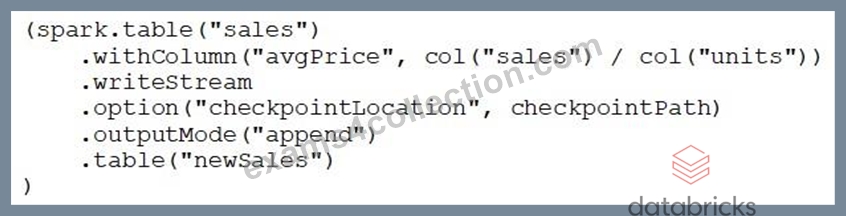
Which of the following Structured Streaming queries is performing a hop from a Silver table to a Gold table?
- A.

- B.

- C.

- D.
- E.

Answer: E
Explanation:
The best practice is to use "Complete" as output mode instead of "append" when working with aggregated tables. Since gold layer is work final aggregated tables, the only option with output mode as complete is option E.
NEW QUESTION # 75
A data engineer needs to apply custom logic to string column city in table stores for a specific use case. In order to apply this custom logic at scale, the data engineer wants to create a SQL user-defined function (UDF).
Which of the following code blocks creates this SQL UDF?
- A.

- B.

- C.

- D.

- E.

Answer: B
Explanation:
https://www.databricks.com/blog/2021/10/20/introducing-sql-user-defined-functions.html
NEW QUESTION # 76
Which of the following data workloads will utilize a Gold table as its source?
- A. A job that cleans data by removing malformatted records
- B. A job that ingests raw data from a streaming source into the Lakehouse
- C. A job that enriches data by parsing its timestamps into a human-readable format
- D. A job that aggregates uncleaned data to create standard summary statistics
- E. A job that queries aggregated data designed to feed into a dashboard
Answer: E
Explanation:
A Gold table is a table that contains highly refined and aggregated data that powers analytics, machine learning, and production applications. It represents data that has been transformed into knowledge, rather than just information. A Gold table is typically the final output of a medallion lakehouse architecture, where data flows from Bronze to Silver to Gold tables, with each layer improving the structure and quality of data. A job that queries aggregated data designed to feed into a dashboard is an example of a data workload that will utilize a Gold table as its source, as it requires data that is ready for consumption and analysis. The other options are either data workloads that will use a Bronze or Silver table as their source, or data workloads that will produce a Gold table as their output. References: Databricks Documentation - What is the medallion lakehouse architecture?, Databricks Documentation - What is a Medallion Architecture?, K21Academy - Delta Lake Architecture & Azure Databricks Workspace.
NEW QUESTION # 77
Which of the following SQL keywords can be used to convert a table from a long format to a wide format?
- A. PIVOT
- B. CONVERT
- C. WHERE
- D. SUM
- E. TRANSFORM
Answer: A
Explanation:
Explanation
The SQL keyword PIVOT can be used to convert a table from a long format to a wide format. A long format table has one column for each variable and one row for each observation. A wide format table has one column for each variable and value combination and one row for each observation. PIVOT allows you to specify the column that contains the values to be pivoted, the column that contains the categories to be pivoted, and the aggregation function to be applied to the values. For example, the following query converts a long format table of sales data into a wide format table with columns for each product and sum of sales:
SELECT *
FROM sales
PIVOT (
SUM(sales_amount) FOR product IN ('A', 'B', 'C')
)
References: The information can be referenced from Databricks documentation on SQL: PIVOT.
https://files.training.databricks.com/assessments/practice-exams/PracticeExam-DataEngineerAssociate.pdf
https://community.databricks.com/t5/data-engineering/practice-exams-for-databricks-certified-data-engineer/td-p
NEW QUESTION # 78
Which of the following is a benefit of the Databricks Lakehouse Platform embracing open source technologies?
- A. Cloud-specific integrations
- B. Simplified governance
- C. Ability to scale storage
- D. Ability to scale workloads
- E. Avoiding vendor lock-in
Answer: E
Explanation:
One of the benefits of the Databricks Lakehouse Platform embracing open source technologies is that it avoids vendor lock-in. This means that customers can use the same open source tools and frameworks across different cloud providers, and migrate their data and workloads without being tied to a specific vendor. The Databricks Lakehouse Platform is built on open source projects such as Apache Spark, Delta Lake, MLflow, and Redash, which are widely used and trusted by millions of developers. By supporting these open source technologies, the Databricks Lakehouse Platform enables customers to leverage the innovation and community of the open source ecosystem, and avoid the risk of being locked into proprietary or closed solutions. The other options are either not related to open source technologies (A, B, C, D), or not benefits of the Databricks Lakehouse Platform (A, B). References: Databricks Documentation - Built on open source, Databricks Documentation - What is the Lakehouse Platform?, Databricks Blog - Introducing the Databricks Lakehouse Platform.
NEW QUESTION # 79
A data engineer needs to create a table in Databricks using data from a CSV file at location /path/to/csv.
They run the following command: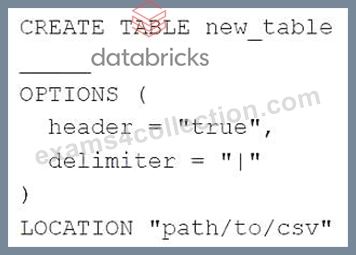
Which of the following lines of code fills in the above blank to successfully complete the task?
- A. FROM "path/to/csv"
- B. USING CSV
- C. None of these lines of code are needed to successfully complete the task
- D. FROM CSV
- E. USING DELTA
Answer: A
Explanation:
A data lakehouse is a new paradigm that can be used to simplify and unify siloed data architectures that are specialized for specific use cases. A data lakehouse combines the best of both data lakes and data warehouses, providing a single platform that supports diverse data types, open standards, low-cost storage, high-performance queries, ACID transactions, schema enforcement, and governance. A data lakehouse enables data engineers to build reliable and scalable data pipelines that can serve various downstream applications and users, such as data science, machine learning, analytics, and reporting. A data lakehouse leverages the power of Delta Lake, a storage layer that brings reliability and performance to data lakes. References: What is a data lakehouse?, Delta Lake, Lakehouse: A New Generation of Open Platforms that Unify Data Warehousing and Advanced Analytics
NEW QUESTION # 80
Which of the following benefits of using the Databricks Lakehouse Platform is provided by Delta Lake?
- A. The ability to distribute complex data operations
- B. The ability to manipulate the same data using a variety of languages
- C. The ability to support batch and streaming workloads
- D. The ability to collaborate in real time on a single notebook
- E. The ability to set up alerts for query failures
Answer: C
Explanation:
Delta Lake is the optimized storage layer that provides the foundation for storing data and tables in the Databricks lakehouse.
Delta Lake is fully compatible with Apache Spark APIs, and was developed for tight integration with Structured Streaming, allowing you to easily use a single copy of data for both batch and streaming operations and providing incremental processing at scale1. Delta Lake supports upserts using the merge operation, which enables you to efficiently update existing data or insert new data into your Delta tables2. Delta Lake also provides time travel capabilities, which allow you to query previous versions of your data or roll back to a specific point in time3. References: 1: What is Delta Lake? | Databricks on AWS 2: Upsert into a table using merge | Databricks on AWS 3: [Query an older snapshot of a table (time travel) | Databricks on AWS] Learn more
1blob:https://www.bing.com/a746b4b4-48d0-4f44-9736-44d1ce0c4228learn.microsoft.com2blob:https://www.bing.com/525fbb0f-e02f-4a70-8085-22c065fe0ca0 medium.com3blob:https://www.bing.com/5cb5bd07-1008-4cf7-9fa3-42a5a689c7d5 slideshare.net4blob:https://www.bing.com/9a7e8352-30c1-4356-a73f-a7253b607ef7 docs.databricks.com5blob:https://www.bing.com/3f65cc27-d573-4810-b272-01238a431c03 github.com6blob:https://www.bing.com/334f6880-dfeb-4e61-bd9a-76efae0a2d01 key2consulting.com
NEW QUESTION # 81
......
Databricks-Certified-Data-Engineer-Associate Exam Dumps Contains FREE Real Quesions from the Actual Exam: https://easytest.exams4collection.com/Databricks-Certified-Data-Engineer-Associate-latest-braindumps.html
